How Agentic AI is Replacing Manual Admin in Care Recruitment
Discover how agentic AI for hiring managers is automating care staff vetting, cutting admin hours, and keeping your recruitment CQC-compliant without the paperwork.

CEO
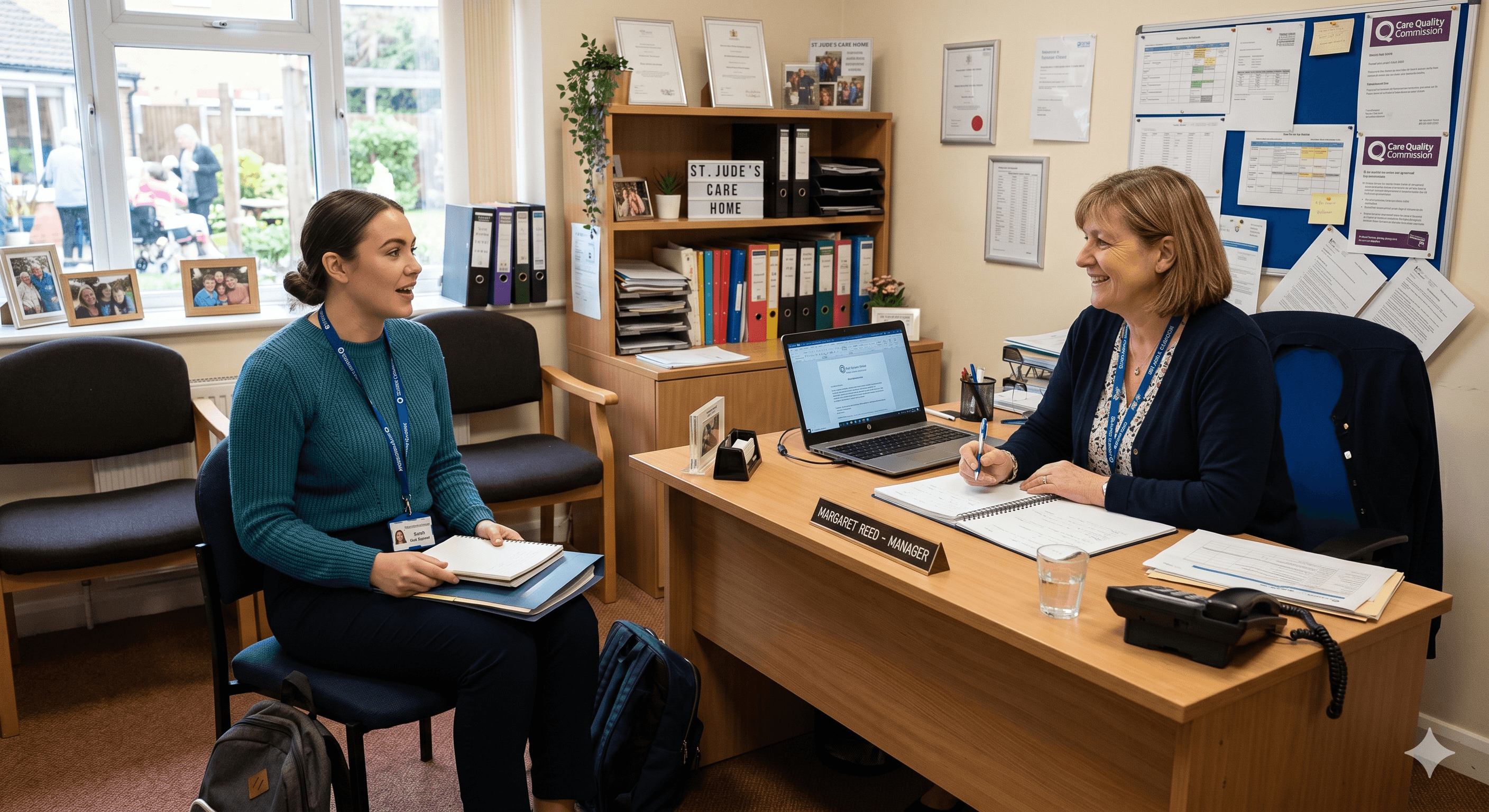
If you run a care business, you know the recruitment grind. It is the endless cycle of chasing references, checking IDs, re-sending the same email to a referee who never replied, and manually updating spreadsheets at 7pm because there was no time during the day. In 2026, a new category of technology called agentic AI for hiring managers is changing that — not by giving you a better dashboard to stare at, but by actually doing the work for you.
The Admin Burden Costing Care Businesses Hours Every Week
Before exploring the solution, it is worth naming the problem precisely, because in care recruitment it is worse than in almost any other sector.
A typical hire in a care business involves: collecting and verifying a CV, conducting an enhanced DBS check, obtaining two written references, confirming right to work, issuing a contract, and completing an induction checklist. Research from Skills for Care estimates that the average time-to-hire in social care sits at around 43 days; significantly longer than the national average across all sectors. A large part of that gap is not interview scheduling or candidate quality. It is administrative lag.
References go unanswered for two weeks. DBS applications get submitted with a digit wrong. Right-to-work documents are scanned but never formally verified. Each of these gaps is not just an inconvenience, in a CQC-regulated environment, it is a compliance risk.
The cost compounds quickly. If your registered manager is spending three hours per hire chasing documents, and you hire 40 people a year, that is 120 hours, three full working weeks spent on tasks that require no skill or judgement. That is time not spent on residents, staff development, or growing the business.
What Is Agentic AI and How Is It Different From Normal Software?
Most recruitment software is passive. It stores information you enter, surfaces data you ask for, and sends reminders you configure. It waits for you.
AI recruitment agents for care work differently. An AI agent is a system that can be given a goal — "ensure this candidate is fully compliant before their start date" — and then pursue that goal autonomously, making decisions and taking actions without needing a human to direct each step.
The distinction matters because it shifts the role of the hiring manager from administrator to supervisor. Instead of executing the compliance checklist yourself, you review a completed one.
Task | Manual Process | Agent led process |
|---|---|---|
Reference request | Manager emails referee | Agent sends request automatically on application |
Follow-up | Manager re-emails after 1 week | Agent sends reminder at 48 hrs, escalates at 7 days |
DBS application | Manager checks form manually | Agent flags incomplete fields before submission |
Right to work | Manager reviews document on screen | Agent verifies against Home Office document list |
Compliance gap | Discovered at audit | Flagged in dashboard before start date |
Onboarding pack | Emailed manually | Sent automatically on offer acceptance |
The agent does not replace your judgement on who to hire. It removes the friction between deciding to hire someone and having them compliantly onboarded.
What Tasks Can an AI Agent Actually Handle in Care Recruitment?
A well-built agentic AI system for care recruitment should be able to handle the following without manual intervention:
Reference chasing and collection The agent sends a structured reference request to each contact the candidate provides, tracks response status, sends timed follow-ups, and marks the requirement as complete once both references meet your criteria. If a referee is unresponsive after a set period, it escalates to the hiring manager with a suggested next step.
DBS application management The agent prompts candidates to submit required identity documents, checks the application for common errors before submission, and monitors tracking status. Once the certificate is received, it is automatically stored against the candidate record and flagged for review if the result requires a decision.
Right to work verification The agent cross-references documents a candidate uploads against the current Home Office acceptable document list, flags anything that does not match, and records the date of verification for your audit trail keeping you compliant with Employer's Liability requirements.
Interview scheduling The agent coordinates availability between candidate and interviewer, sends calendar invitations, and issues reminders 24 hours before. Rescheduling requests are handled automatically within parameters you set.
Onboarding document collection Once an offer is made, the agent issues the full onboarding pack, tracks which documents have been returned and signed, and sends reminders for outstanding items. You see a live completion percentage for each new starter not an inbox full of attachments.
Compliance dashboard monitoring All of the above feeds into a single compliance view. Any candidate with an outstanding item is flagged clearly. Expiring documents,such as a DBS certificate approaching its renewal window trigger automatic reminders before they become a problem.
Is It Compliant With CQC Standards?
This is the first question most care operators ask, and it is the right one.
CQC's Safe recruitment standards require that providers obtain satisfactory references, verify identity, complete an enhanced DBS check, and confirm right to work before a new employee has unsupervised contact with service users. The Fundamental Standards do not specify how these checks are completed only that they are completed and evidenced.
Agentic AI does not shortcut any of these checks. It automates the process of requesting, tracking, and storing the evidence. Every action the agent takes is logged with a timestamp, creating an audit trail that is often more robust than manual record-keeping, where documentation can be incomplete or inconsistently filed.
That said, the hiring manager remains responsible for reviewing the outputs and making the final decision. The agent handles the administration. The accountable person remains human.
Frequently Asked Questions
What is agentic AI in recruitment? Agentic AI refers to systems that can take actions autonomously to complete a defined goal. In recruitment, this means an AI that can chase references, track compliance documents, and manage candidate communications without a human initiating each step.
How is this different from an ATS? A traditional ATS organises information and can send templated messages, but a human must trigger each action. An agentic AI layer acts on the data autonomously deciding what needs to happen next and executing it.
Do I need technical staff to set it up? No. Our system is configured during onboarding by our implementation team. Most care providers are live within two weeks, with no IT resource required on your side.
What happens if the AI makes a mistake? All agent actions are logged and visible to the hiring manager. Nothing is finalised without a human review step at key compliance decision points. The agent handles the legwork, not the judgement calls.
Is my candidate data secure? Yes. The platform is UK GDPR compliant, hosted on UK servers that are ISO 27001 certified.
The Bottom Line
The goal of technology in care should not be to make your operation more complex. It should be to give your team their time back so they can focus on what actually matters; quality of care, staff development, and running a sustainable business.
Agentic AI for hiring managers does not replace the people in your recruitment process. It replaces the paperwork. And for most care providers, that is the thing that was quietly consuming the most time.
[Book a 15-Minute "No-Tech" Demo See Our AI Agents in Action]
No slides. No jargon. We will show you exactly what the agent does with a live candidate profile from your sector.
SHARE